


Upset about Miaoli County’s renewed demolition order for the last four households in the farming village of Dapu (大埔) in Jhunan Township (竹南), affected residents and their supporters yesterday protested outside the Executive Yuan, calling on Premier Jiang Yi-huah (江宜樺) to intervene on their behalf.
Holding up a large banner that read “The Dapu dispute is not solved yet” and placards that read “Save Dapu on July 5,” dozens of people — including affected Dapu residents and supporters — rallied outside the Executive Yuan ahead of the self-demolition deadline set for Friday next week.
“The government is no different from a robber. The land on which our family house was built is for residential use, but the county government wants to flatten our home to make way for a science park,” said Ko Chih-chuan (柯智傳), one of the affected residents. “Does this make any sense to any of you?”
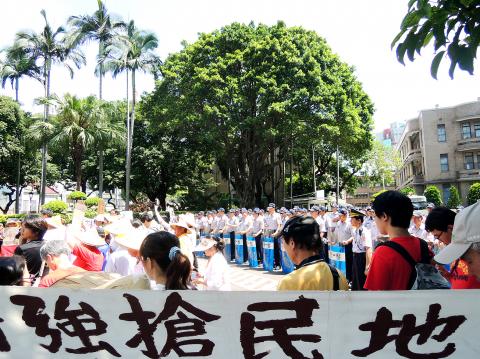
Photo: Taipei Times
Taiwan Rural Front chairman Hsu Shih-jung (徐世榮) said that, amid protests three years ago against land seizure by the government in Dapu to make way for a science park, Vice President Wu Den-yih (吳敦義), who was premier at the time, called a meeting attended by Miaoli County Commissioner Liu Cheng-hung (劉政鴻), Straits Exchange Foundation Secretary-General Lin Join-sane (林中森), who was the Cabinet secretary-general at the time, and Jiang, who was minister of the interior.
The meeting reached a conclusion to preserve the remaining four houses, while finding a plot of land where the affected families could relocate their houses and farms.
However, the Ministry of the Interior later decided to flatten the houses anyway and, while Dapu residents are still in the middle of an administrative lawsuit against the county government and the ministry, they received a renewed demolition order last week, asking them to demolish their own houses by July 5 or face forced demolition by the county.
“We are here because Jiang, as interior minister at the time, also made the promise along with Wu, and in fact, Wu came to the conclusion to preserve the remaining houses because the ministry said there would be no problem after an assessment,” said Liao Pen-chuan (廖本全), an associate professor at National Taipei University’s Department of Real Estate and Built Environment.
“Jiang is a liar,” he added.
Acting Construction and Planning Agency director-general Hsu Wen-lung (許文龍), who received the protesters, said that the agency would try its best to help.
“However, ultimately it is the county government that has final say,” Hsu said.


RESILIENCE: Taiwan plays a key role in semiconductors, energy, information infrastructure and advanced manufacturing, AIT Director Raymond Greene said Taiwan’s continued investment in deterrence and resilience remains vital, especially in uncrewed systems and other emerging technologies, American Institute in Taiwan (AIT) Director Raymond Greene said yesterday. Greene made the remarks at the annual National Strategic Summit on Supply Chain Resilience held by the Research Institute for Democracy, Society and Emerging Technology (DSET), a government-backed think tank. As Taiwan last year became the US’ fourth-largest trading partner and supply chain security is becoming more important, cooperation in emerging technologies continues to deepen between the two countries, he said. The US is committed to accelerating innovation, building key infrastructure, strengthening cooperation

The National Chungshan Institute of Science and Technology yesterday showcased its locally developed variants of the Vision 60 robotic patrol dog, which it plans to deploy on the nation’s outlying territories in the South China Sea. The variants were produced under the Joint Lab project — created by the institute and domestic companies — and assembled with domestically produced motors, lenses and artificial intelligence (AI) systems alongside licensed tech from the US, Missile and Rocket Systems Research Division deputy director Jen Kuo-kang (任國光) told the media event at a military base in Taipei’s Dazhi (大直) area. Taiwan has built up its strengths

RIGHT DIRECTION: Taiwan’s efforts to prevent forced labor include a proposal to ‘fully prohibit’ employers from withholding workers’ documents, an official said Taiwan is to establish a mechanism to restrict imports of goods linked to forced labor, the Executive Yuan said yesterday, after the US proposed imposing additional tariffs on Taiwanese goods over labor concerns. “The Ministry of Labor and the Ministry of Economic Affairs are to establish an interministerial review procedure,” Executive Yuan spokesperson Michelle Lee (李慧芝) said at a news briefing in Taipei. “The government is to use the Foreign Trade Act [貿易法] as the legal basis to restrict imports of goods produced with forced labor” and bring its supply chain governance more in line with international standards on human rights, resilience

NOT IMMEDIATE: Taiwan has a chance to appeal the proposed 10 percent tariff before it starts, while other countries face a 12.5 percent tariff from the trade office Taiwan is among 60 economies determined by the US to have failed to impose or enforce a ban on the importation of goods produced with forced labor, according to a notice released on Tuesday by the Office of the US Trade Representative (USTR), which proposed imposing an additional 10 percent or more tariff on them. The USTR in a statement said that following an investigation, it had determined under Section 301 of the Trade Act of 1974 that the failure of the 60 economies to impose and effectively enforce a prohibition on the importation of goods produced with forced labor is


 RSS
RSS